


С кървави длани
премръзнал хлапак
като стар ветеран
скита се пак.
Преметнал торбичка
със сухи кори
и мънички камъчета
от детски игри.
С поглед опушен,
пепеляви коси,
малката сянка
из фронта пълзи.
Бърше с юмручета
прашни очи,
зеят окопите
с мъртви сълзи.
Птици объркано
с крясък кръжат
гълтат пожарите
жълт листопад
Спрете куршумите!
Запушете дула!
Прегризете оковите
на абсурдна война!
Прегърнете, прекъснали
бесния бяг,
вашата съвест
в този хлапак!
премръзнал хлапак
като стар ветеран
скита се пак.
Преметнал торбичка
със сухи кори
и мънички камъчета
от детски игри.
С поглед опушен,
пепеляви коси,
малката сянка
из фронта пълзи.
Бърше с юмручета
прашни очи,
зеят окопите
с мъртви сълзи.
Птици объркано
с крясък кръжат
гълтат пожарите
жълт листопад
Спрете куршумите!
Запушете дула!
Прегризете оковите
на абсурдна война!
Прегърнете, прекъснали
бесния бяг,
вашата съвест
в този хлапак!
inviata da Riccardo Venturi + CCG/AWS Staff - 27/11/2025 - 18:40
Lingua: Italiano
Versione italiana / Italian version / Version italienne / Italiankielinen versio:
Riccardo Venturi, 27-11-2025 19:07
Riccardo Venturi, 27-11-2025 19:07
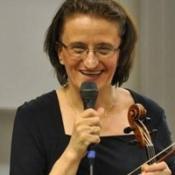
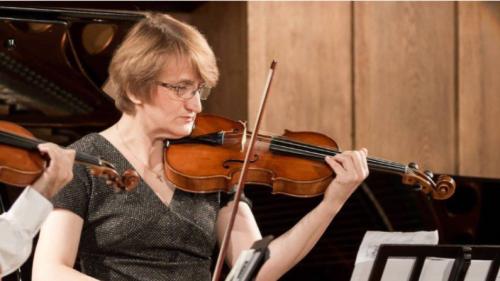
Dr Devorina Gamalova
Violinist Devorina Gamalova and her optimistic theory of humanity
Published on 8/9/25 11:15 AM Author: Tsvetana Toncheva
A successful soloist and renowned teacher, Bulgarian violinist Devorina Gamalova has lived in London for more than three decades. She was born in Bulgaria's town of Gabrovo, to a Bulgarian father and a German mother from Dresden. She studied in Ruse and at the National Music Academy "Prof. Pancho Vladigerov" in Sofia in the class of the legendary Boyan Lechev. In 1988, she left for Germany. She specialized in violin and viola with Prof. Grigori Zhislin at the Royal College of Music in London. In 2002, Gamalova completed a second higher education in Sofia - theology, and in 2008 she defended her doctoral dissertation in London.
For more than 35 years, Devorina Gamalova has been actively performing as a soloist and chamber musician in Bulgaria, Germany, Great Britain, Italy, and France. She collaborates with the organization "Live Music Now", founded by Yehudi Menuhin. She taught violin and viola first at South Downs College. From 1999 to 2003 she assisted Prof. Grigori Zhislin at the Royal College of Music, and is currently a teacher at Goldsmith University of London, Birmingham Conservatoire, Trinity College of Music and London College of Music. She is interested in all arts, religion and philosophy, languages. She writes and translates, has many publications in Bulgarian and German.
Recently, during the International Festival "Sofia Music Weeks", her book "Music and Spiritual Life. Interaction in the Light of the Orthodox Christian Tradition" was presented - an impressive study in which the author proves that music and Christianity are one and the same thing.
For the audience of Radio Bulgaria, Devorina Gamalova first shares the curious story of her family. "My mother is German. My entire family comes from Dresden on the German side. My mother studied Russian and English philology at the University of Leipzig, where they wanted to open a department for studying Bulgarian. That's why they sent her and another colleague of hers to Bulgaria to study Bulgarian philology. At that time, my father was studying theology and they met by chance... The interesting thing is that my mother had to sign a document that she would under no circumstances get married in Bulgaria. She had to return to Germany and work for this Bulgarian language department. And she never imagined that such a thing could happen to her... And why Gabrovo? Because my father was out of favor and wanted to go further than his hometown, where he had problems, and my mother traveled all over Bulgaria during her studies... and she liked Gabrovo the most. That's how they decided to settle there."
Devorina has two twin brothers. The family has problems because of her grandfather, who before September 9, 1944, was a manufacturer and his heirs were persecuted by the new Communist regime. As a child, she was surrounded by books and records, to which her mother devoted every free moment and the girl was fascinated by their beauty. Her grandfather's children were not allowed to study anything except theology. Her father, although he wanted to become a doctor, took advantage of the opportunity and subsequently worked as a church singer for several decades. The persecution also reached the grandchildren, but Devorina was accepted to study in Ruse, and then in Sofia. As a graduate of one of the most famous violin teachers in our history, I ask her to share her impressions of the so-called "Boyan Lechev school".
"I thought I needed such an academic and systematic person. That's why I wrote in my application that I would like to study with him, although I had no hope of that happening. But since that very year he had taken Dora Brachkova as his assistant and he needed a few students, maybe that was my chance and I ended up in his class. And his school is great! I don't know how much is still remembered about it now, but he had trained so many - both soloists and concertmasters, top-class violinists. And Dora Brachkova was also very talented as a teacher - and continues to be! Prof. Lechev was very consistent and very clear. He didn't talk much. His remarks were short, businesslike, very clear and very influential."
Gamalova left Bulgaria immediately after graduating from university. After a seminar in Weimar, she entered a competition for concertmaster of the symphony orchestra in the city of Riesa. Her fateful meeting with the great Russian violinist and teacher Grigori Zhislin followed. Invited to become a professor in London, he accepted her into his class: "So, without ever having any aspiration or interest in England, I ended up there".
Devorina still lives in London today and loves this city very much. In England, she found a great spiritual center - the monastery of St. Sophrony Sakharov. This encounter was impressive and turned her life upside down. After some time, she decided to study theology. It sounds strange, but did Gamalova really discover Orthodoxy in England, and not in Bulgaria?
"Well, yes, it's interesting... I've always been Orthodox, but you know how it was at that time - you couldn't talk much. My parents, although they raised us in this spirit, theoretically didn't talk about these things and I had a lot of confusion, questions. And they were indeed resolved in England - all the questions that worried me and I had no answer for them... I noticed that I knew very little about our Orthodox Christian faith... At one point, I even became embarrassed and ashamed that I knew so little about this faith, because of which my people had survived over the centuries. This was the main motivation for deciding to enroll in theology."
Among her fellow students in Sofia was an emblematic figure today – novice Daniil, who is now His Holiness Patriarch Daniil of the Bulgarian Orthodox Church.
"As a student, he was exceptional, remarkable! Very purposeful, very persistent and firm in his faith. Terribly well-read - we kept asking him questions. I recently saw him at the consecration of the Bulgarian church in London and I am glad that he has remained the way he was then."
Devorina believes that music alleviates suffering, helps with work, and has an entirely beneficial influence on people. What does Gamalova want to say with her latest book - "Music and Spiritual Life"?
"Initially, this book began as a reflection on inspiration. I have always been deeply impressed by this phenomenon - inspiration. And I could say that this book is a book about inspiration, written with inspiration - at least in most cases. I had a great impulse and somehow the thoughts came to me one after another. Where and how they should be arranged and what exactly I should pay attention to - I did not look for it, it just came. I was only looking for supporting literature that would support my reflections and discoveries - more authoritative sources than I can be. Everyone can find something for themselves in this book. It is not necessary to read it from cover to cover. But one can leaf through the contents, see which topics interest them and read them."
An active teacher for decades, Gamalova communicates with many young people. I ask her if she thinks that today they are much more self-confident, arrogant, aggressive, but also much less educated and prepared than those of 30-40 years ago? What does she think is the future of the world with these young people? And can they be changed?
"I am very wary of such global generalizations. There are always, at any time, this type of people - and that type of people. There are arrogant souls, there are pure souls who strive for art with all their heart and desire, not out of any selfish impulses. Just as there were in our time, there are also now these young people who really love music and want to be committed to music. The fact that there is perhaps a little more arrogance in our time in general - not only in the musical spheres, is due to the entire logistics and philosophy of life in society. Because man is placed at the center of everything, and not only man, but the Ego. And this Ego is what makes a person arrogant at a given moment - because he thinks that what he achieves or is given as a gift is his personal merit and conquest. And without outside help he could never have reached where he reaches, if these are any heights... I am glad that I still see young people who want to do music. It is different in different countries. In Bulgaria, the situation is far better than it is in England. And I would like to wish all those who are in music schools or in the Music Academy – not to lose courage, but to continue. Because music is a huge wealth, which may not be as profitable as finances, but it gives such inner strength and joy that no money can buy or give".
What is the first thing that comes to mind when Bulgaria is mentioned?
"The beautiful, magnificent nature and the warm-hearted and spontaneous people, which we have in abundance on our land," answers Devorina Gamalova. So her theory about the Bulgarian people is optimistic?
"Oh, definitely! I am generally very optimistic about humanity and life. Because I know how things could improve. But a person must want his or her life to become better..."
Is she satisfied with her life?
"Extremely. Yes, extremely! I am a very happy person. I have received many, very valuable things. I have learned many valuable things. Naturally - through many difficulties. I am grateful for these trials, because they have taught me to see the people around me, and not only my own self."
Published on 8/9/25 11:15 AM Author: Tsvetana Toncheva
A successful soloist and renowned teacher, Bulgarian violinist Devorina Gamalova has lived in London for more than three decades. She was born in Bulgaria's town of Gabrovo, to a Bulgarian father and a German mother from Dresden. She studied in Ruse and at the National Music Academy "Prof. Pancho Vladigerov" in Sofia in the class of the legendary Boyan Lechev. In 1988, she left for Germany. She specialized in violin and viola with Prof. Grigori Zhislin at the Royal College of Music in London. In 2002, Gamalova completed a second higher education in Sofia - theology, and in 2008 she defended her doctoral dissertation in London.
For more than 35 years, Devorina Gamalova has been actively performing as a soloist and chamber musician in Bulgaria, Germany, Great Britain, Italy, and France. She collaborates with the organization "Live Music Now", founded by Yehudi Menuhin. She taught violin and viola first at South Downs College. From 1999 to 2003 she assisted Prof. Grigori Zhislin at the Royal College of Music, and is currently a teacher at Goldsmith University of London, Birmingham Conservatoire, Trinity College of Music and London College of Music. She is interested in all arts, religion and philosophy, languages. She writes and translates, has many publications in Bulgarian and German.
Recently, during the International Festival "Sofia Music Weeks", her book "Music and Spiritual Life. Interaction in the Light of the Orthodox Christian Tradition" was presented - an impressive study in which the author proves that music and Christianity are one and the same thing.
For the audience of Radio Bulgaria, Devorina Gamalova first shares the curious story of her family. "My mother is German. My entire family comes from Dresden on the German side. My mother studied Russian and English philology at the University of Leipzig, where they wanted to open a department for studying Bulgarian. That's why they sent her and another colleague of hers to Bulgaria to study Bulgarian philology. At that time, my father was studying theology and they met by chance... The interesting thing is that my mother had to sign a document that she would under no circumstances get married in Bulgaria. She had to return to Germany and work for this Bulgarian language department. And she never imagined that such a thing could happen to her... And why Gabrovo? Because my father was out of favor and wanted to go further than his hometown, where he had problems, and my mother traveled all over Bulgaria during her studies... and she liked Gabrovo the most. That's how they decided to settle there."
Devorina has two twin brothers. The family has problems because of her grandfather, who before September 9, 1944, was a manufacturer and his heirs were persecuted by the new Communist regime. As a child, she was surrounded by books and records, to which her mother devoted every free moment and the girl was fascinated by their beauty. Her grandfather's children were not allowed to study anything except theology. Her father, although he wanted to become a doctor, took advantage of the opportunity and subsequently worked as a church singer for several decades. The persecution also reached the grandchildren, but Devorina was accepted to study in Ruse, and then in Sofia. As a graduate of one of the most famous violin teachers in our history, I ask her to share her impressions of the so-called "Boyan Lechev school".
"I thought I needed such an academic and systematic person. That's why I wrote in my application that I would like to study with him, although I had no hope of that happening. But since that very year he had taken Dora Brachkova as his assistant and he needed a few students, maybe that was my chance and I ended up in his class. And his school is great! I don't know how much is still remembered about it now, but he had trained so many - both soloists and concertmasters, top-class violinists. And Dora Brachkova was also very talented as a teacher - and continues to be! Prof. Lechev was very consistent and very clear. He didn't talk much. His remarks were short, businesslike, very clear and very influential."
Gamalova left Bulgaria immediately after graduating from university. After a seminar in Weimar, she entered a competition for concertmaster of the symphony orchestra in the city of Riesa. Her fateful meeting with the great Russian violinist and teacher Grigori Zhislin followed. Invited to become a professor in London, he accepted her into his class: "So, without ever having any aspiration or interest in England, I ended up there".
Devorina still lives in London today and loves this city very much. In England, she found a great spiritual center - the monastery of St. Sophrony Sakharov. This encounter was impressive and turned her life upside down. After some time, she decided to study theology. It sounds strange, but did Gamalova really discover Orthodoxy in England, and not in Bulgaria?
"Well, yes, it's interesting... I've always been Orthodox, but you know how it was at that time - you couldn't talk much. My parents, although they raised us in this spirit, theoretically didn't talk about these things and I had a lot of confusion, questions. And they were indeed resolved in England - all the questions that worried me and I had no answer for them... I noticed that I knew very little about our Orthodox Christian faith... At one point, I even became embarrassed and ashamed that I knew so little about this faith, because of which my people had survived over the centuries. This was the main motivation for deciding to enroll in theology."
Among her fellow students in Sofia was an emblematic figure today – novice Daniil, who is now His Holiness Patriarch Daniil of the Bulgarian Orthodox Church.
"As a student, he was exceptional, remarkable! Very purposeful, very persistent and firm in his faith. Terribly well-read - we kept asking him questions. I recently saw him at the consecration of the Bulgarian church in London and I am glad that he has remained the way he was then."
Devorina believes that music alleviates suffering, helps with work, and has an entirely beneficial influence on people. What does Gamalova want to say with her latest book - "Music and Spiritual Life"?
"Initially, this book began as a reflection on inspiration. I have always been deeply impressed by this phenomenon - inspiration. And I could say that this book is a book about inspiration, written with inspiration - at least in most cases. I had a great impulse and somehow the thoughts came to me one after another. Where and how they should be arranged and what exactly I should pay attention to - I did not look for it, it just came. I was only looking for supporting literature that would support my reflections and discoveries - more authoritative sources than I can be. Everyone can find something for themselves in this book. It is not necessary to read it from cover to cover. But one can leaf through the contents, see which topics interest them and read them."
An active teacher for decades, Gamalova communicates with many young people. I ask her if she thinks that today they are much more self-confident, arrogant, aggressive, but also much less educated and prepared than those of 30-40 years ago? What does she think is the future of the world with these young people? And can they be changed?
"I am very wary of such global generalizations. There are always, at any time, this type of people - and that type of people. There are arrogant souls, there are pure souls who strive for art with all their heart and desire, not out of any selfish impulses. Just as there were in our time, there are also now these young people who really love music and want to be committed to music. The fact that there is perhaps a little more arrogance in our time in general - not only in the musical spheres, is due to the entire logistics and philosophy of life in society. Because man is placed at the center of everything, and not only man, but the Ego. And this Ego is what makes a person arrogant at a given moment - because he thinks that what he achieves or is given as a gift is his personal merit and conquest. And without outside help he could never have reached where he reaches, if these are any heights... I am glad that I still see young people who want to do music. It is different in different countries. In Bulgaria, the situation is far better than it is in England. And I would like to wish all those who are in music schools or in the Music Academy – not to lose courage, but to continue. Because music is a huge wealth, which may not be as profitable as finances, but it gives such inner strength and joy that no money can buy or give".
What is the first thing that comes to mind when Bulgaria is mentioned?
"The beautiful, magnificent nature and the warm-hearted and spontaneous people, which we have in abundance on our land," answers Devorina Gamalova. So her theory about the Bulgarian people is optimistic?
"Oh, definitely! I am generally very optimistic about humanity and life. Because I know how things could improve. But a person must want his or her life to become better..."
Is she satisfied with her life?
"Extremely. Yes, extremely! I am a very happy person. I have received many, very valuable things. I have learned many valuable things. Naturally - through many difficulties. I am grateful for these trials, because they have taught me to see the people around me, and not only my own self."
Fermatevi!
Con i palmi insanguinati,
Un bambino assiderato
Sta di nuovo vagando
Come un vecchio veterano.
Porta una borsa piena
Di corteccia secca
E di piccoli sassolini
Da giochi di bambini.
Con lo sguardo spento
E i capelli color cenere,
Quella piccola ombra
Procede strisciando.
A mani chiuse si asciuga
Gli occhi impolverati,
Lo guardano le trincee
Con lacrime morte.
Confusi, volteggiano
Uccelli, urlando.
Inghiotton gli incendi
Le foglie ingiallite.
Fermate i proiettili!
Intasate le canne!
Corrodete le catene
Di una guerra assurda!
Fermatevi! Non correte
Più furiosi, e abbracciate
La vostra coscienza
In questo bambino!
Con i palmi insanguinati,
Un bambino assiderato
Sta di nuovo vagando
Come un vecchio veterano.
Porta una borsa piena
Di corteccia secca
E di piccoli sassolini
Da giochi di bambini.
Con lo sguardo spento
E i capelli color cenere,
Quella piccola ombra
Procede strisciando.
A mani chiuse si asciuga
Gli occhi impolverati,
Lo guardano le trincee
Con lacrime morte.
Confusi, volteggiano
Uccelli, urlando.
Inghiotton gli incendi
Le foglie ingiallite.
Fermate i proiettili!
Intasate le canne!
Corrodete le catene
Di una guerra assurda!
Fermatevi! Non correte
Più furiosi, e abbracciate
La vostra coscienza
In questo bambino!
Lingua: Inglese
English version / Versione inglese / Version anglaise / Englanninkielinen versio:
Riccardo Venturi, 28-11-2025 10:16
Riccardo Venturi, 28-11-2025 10:16
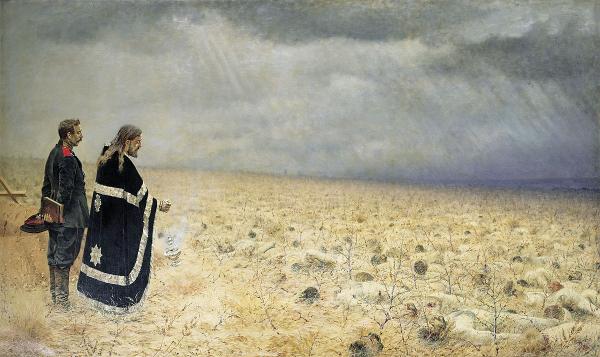
Vasiliy Vereshchagin, The Vanquished, 1872. Moscow, Tret'yakov Gallery.
Vasilij Vereščagin, I Vinti, 1872. Mosca, Galleria Tret’jakov.
Vasilij Vereščagin, I Vinti, 1872. Mosca, Galleria Tret’jakov.
Stop!
With bloodstained hands,
A child, frozen to death,
Is wandering again
Like an old veteran.
He’s carrying a bag
Full of dry bark
And small pebbles -
Like in children’s games.
With his dull eyes
And ashstained hair,
That little shadow
Is crawling along.
With closed hands, he dries
His dust covered eyes,
The trenches look at him
With dead tears.
Birds are circling
Around him, confused.
The fires swallow
The yellow leaves.
Stop the bullets!
Clog the gun barrels!
Dissolve the chains
Of an absurd war!
Stop! Don’t run
In fury anymore!
Embrace your conscience
In this child.
With bloodstained hands,
A child, frozen to death,
Is wandering again
Like an old veteran.
He’s carrying a bag
Full of dry bark
And small pebbles -
Like in children’s games.
With his dull eyes
And ashstained hair,
That little shadow
Is crawling along.
With closed hands, he dries
His dust covered eyes,
The trenches look at him
With dead tears.
Birds are circling
Around him, confused.
The fires swallow
The yellow leaves.
Stop the bullets!
Clog the gun barrels!
Dissolve the chains
Of an absurd war!
Stop! Don’t run
In fury anymore!
Embrace your conscience
In this child.
×
![]()

[2015]
Lyrics and music / Testo e musica / Paroles et musique / Sanat ja sävel: Devorina Gamalova / Деворина Гамалова
"Dedicato a tutti i grandi conquistatori,
passati, presenti e futuri."
Vasiliy Vereshchagin: The Apotheosis of War, 1871. Moscow, Tret'yakov Gallery.
"Dedicated to all great conquerors, past, present and to come"