 MusicBrainz
 Discogs
 United Kingdom
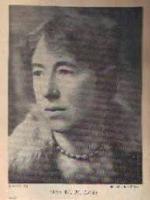 Winifred M. Letts
Winifred M. Letts (10 February 1882 – 7 June 1972) was a writer who spent most of her life in Ireland. She was known for her poetry, novels, and plays.
Winifred Mabel Letts was born on 10 February 1882 to Mary Isabel (née Ferrier) and Reverend Ernest Frederick Letts.[1][Note 1] It is widely accepted by biographers that she was born in Salford, Lancashire, England.[2][3] She was educated first at St. Anne’s School, Abbots Bromley, Staffordshire and later Alexandra College in Dublin, Ireland.
She spent summer childhood holidays in Knockmaroon Park, Dublin, her maternal grandparents' home. After her father's death, she and her mother moved to Ireland from England and lived on Glenart Avenue and, later, on Avoca Avenue, in a house called Dal Riada, in the Dublin suburb of Blackrock.
In 1915, during World War I, Letts joined the Volunteer Aid Detachment and was assigned to the Manchester Base Hospital in England. Trained to offer physical therapy to wounded soldiers, she served with the Almeric Paget Massage Corps in Manchester and Alnwick, Northumberland.
In 1926 she married widower William Henry Foster Verschoyle. William died in 1943 and Letts moved to England to live with her sisters in Faversham, Kent.
In the 1950s, she returned to Ireland and purchased Beech Cottage in Killiney, County Dublin.[2] She moved to Tivoli Nursing Home, Dún Laoghaire, in the late 1960s. Letts died on 7 June 1972 and is buried in Rathcoole, County Dublin. A memorial plaque celebrating her life and work was unveiled in Rathcoole by President Michael D. Higgins on 20 June 2022.
Poetry
Letts was active in the artistic circles of Dublin. She was a member of the Irish Women Writers' Club. She collaborated with several artists at the Cuala Press to create illustrated broadsides of her poems.
Letts is remembered today as a poet of the First World War; however, her first publications were lyric poetry exploring Irish folk themes popularised by the Celtic Revival. An early poem, 'The Sense of Faery', was published in 1904 in the English literary magazine Occasional Papers. with further poetry appearing in the Westminster Gazette and the Manchester City News (1906). Her first poetry collection, Songs from Leinster, was published in 1913. In 1916, by which time she was working as a nurse, she published Hallowe'en and Other Poems of the War. The collection was re-issued in 1917 as The Spires of Oxford, and Other Poems.
The publisher's preface to The Spires of Oxford stated, ‘The verdict of the public, as shown by continual requests to republish, is that The Spires of Oxford is the most important poem in the volume—and therefore in issuing a new edition with several new poems, we bow to this verdict and give The Spires of Oxford its place in the forefront of the volume’. The poem 'The Spires of Oxford' appeared in at least two anthologies published in America during the war, John William Cunliffe’s Poems of the Great War (1916)[18] and George Herbert Clarke’s A Treasury of War Poetry (1917.] Two lines from the poem are inscribed on the Soldiers Memorial Gate at Brown University, dedicated in 1921: 'They gave their merry youth away / For country and for God'.
Until the 1980s, Letts’s war poetry was largely forgotten. In his 1922 Anthology of Irish Verse, Padraic Colum included 'Synge’s Grave' rather than her war poems. As contemporary literary critics point out, poetry that privileged men’s experience of combat and that forged new directions in modernism was preferred over works that described the experiences of women during the war, particularly those on the Home Front. Stacy Gillis points to a new interest in women's experience that emerged in the 1980s and 1990s, when several critical studies of women’s war poetry were published, as well as the 1981 anthology Scars Upon My Heart, which included several poems by Letts.]
Recent assessments of Letts’s war poetry have pointed to her use of irony in war poems such as 'What Reward?', 'Screens', and 'The Deserter'. 'Letts is at her best when she tackles the casualties largely left out of the official narrative', Jim Haughey writes. Jane Dowson also focuses on the 'anti-heroic' aspects of poems such as 'The Deserter'.
However, David Clare notes the complicated legacy of Letts’s war poems within Irish history: ‘World War I's problematic status in Irish memory has meant that the Irish literary canon (as it is currently conceived) still has a hard time accommodating works that are simultaneously very Irish and yet also bound up with the British effort in the World War’.